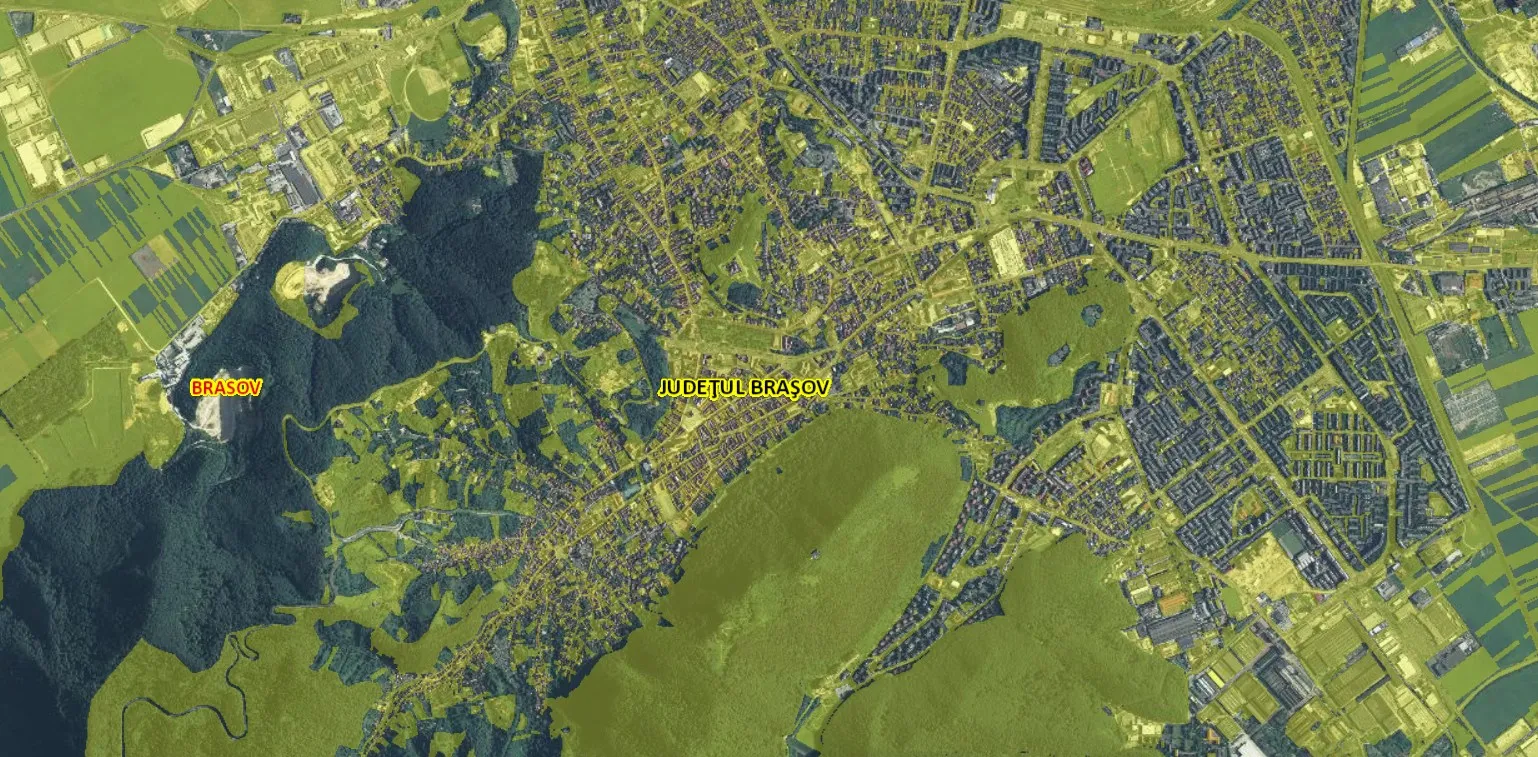
Aerial cadastral map of Brașov city and county
ANCPI Authorized · Brașov, Romania

We measure the land,
with precision.

Complete cadastral, surveying and land-registration services. 13 years of hands-on experience — for property owners and developers alike.

13years experience
1,600+projects completed
100%ANCPI-compliant
Services

Everything cadastral and topographic

Complete services for owners, developers and companies — under one roof.

Cadastral documentation

Cadastral documentation is your property’s “identity card” — the file that officially ties it to the state records.

In detail, the cadastral documentation shows where the property is, its real shape and area, and assigns it a unique number (the cadastral number) in the Cadastre Office records. It is prepared for apartments, houses and land.

You need it at almost every important moment in a property’s life: when you sell or buy, inherit, take out a mortgage, or simply want the property correctly and legally registered. Without documentation accepted by OCPI, a property cannot be entered in the land registry and cannot be transacted at a notary.

For you the process is simple: we come on site, accurately measure the boundaries, calculate the real area and prepare the official plan. We then file the case with the Cadastre Office and handle everything until you receive the cadastral number and the final documentation, ready to use at the notary or the bank.

Typically, the field measurement takes a few hours and preparing and filing the case takes a few days. After filing, the Cadastre Office has a legal processing deadline; we track the file and keep you posted at every step, so you don’t have to queue or decode technical terms.

A common case: you inherited a house but the land was never registered. Before selling it or dividing it among heirs, you need cadastral documentation. The same applies to newly built properties, which must be entered into the records for the first time.

What’s included

  • Field measurements and identification of the property boundaries
  • Calculation of the actual property area
  • Preparation of the location and delimitation plan
  • Submission and acceptance of the file at OCPI / BCPI Brașov

Required documents

  • Title deed (sale contract, inheritance certificate, ownership title, etc.)
  • Owner’s ID document
  • Local tax certificate (where applicable)
  • Previous cadastral documentation, if any

Applicable legislation

  • Law no. 7/1996 on cadastre and real-estate publicity, republished
  • ANCPI Director-General Order no. 700/2014 — Regulation on approval, acceptance and registration in cadastre and land-registry records

Every situation is different — tell us what you have and we’ll prepare a clear, no-obligation quote.

Request a quote →

Land registration (Land Book)

Land registration is the step that makes you the official, fully recognized owner of the property.

Land registration (intabulare) means recording your ownership right in the land registry — the public register the state keeps for every property. From that moment your right is recognized and enforceable against everyone: nobody can claim they did not know who the owner is.

Why it matters: only after registration are you legally considered the full owner. It is mandatory when buying a home, obtaining a mortgage and for most transactions. The land registry also shows any mortgages, easements or other charges, so it provides security for both you and a future buyer.

We first check the property’s legal status, prepare or update the cadastral documentation if needed, file the request with the Land Registry Office, and hand you the land-registry conclusion and excerpt confirming you are registered as the owner.

Land registration and cadastral documentation often go together: if the property has no cadastral number yet, it is first surveyed, then registered. If it already has one, we handle the registration of your right directly and give you the updated land-registry excerpt.

It is the step that gives you peace of mind: once registered, you have full official proof that the property is yours, recognized by banks, notaries and courts. In practice, nothing important can be done with the property without your consent.

What’s included

  • Review of the property’s legal status
  • Preparation or updating of the required cadastral documentation
  • Filing the registration request with the Land Registry Office (BCPI)
  • Obtaining the land-registry conclusion and excerpt

Required documents

  • Title deed
  • Accepted cadastral documentation (if the property has no cadastral number)
  • Owner’s ID document

Applicable legislation

  • Law no. 7/1996, republished
  • Civil Code — Law no. 287/2009 (land registry, art. 876 et seq.)
  • ANCPI Order no. 700/2014

Every situation is different — tell us what you have and we’ll prepare a clear, no-obligation quote.

Request a quote →

Topographic surveys

A topographic survey is the foundation of any building project — the land measured correctly, ready for designers and the city hall.

A topographic survey is the detailed measurement of a piece of land: its shape, dimensions, height differences, existing buildings and features. The result is a precise plan, drawn in Romania’s official coordinate system (Stereographic 1970), which architects, engineers and authorities then use.

You need a topographic plan whenever you want to build or extend, obtain a building permit, prepare urban-planning documentation (PUZ/PUD) or design an infrastructure project. Without correctly measured land, the designer cannot draw and the city hall cannot issue the permit.

We use a total station and GNSS equipment for maximum precision, calculate areas and volumes where needed, and deliver the plan in digital format (DWG/DXF) and printed, ready for your design team.

The topographic plan usually also includes a network of reference points, contour lines and ground elevations, so the designer knows exactly how the land slopes and where the building can sit. For larger projects, we also produce detailed plans for specific areas.

If you’re not sure what type of plan the city hall or designer requires, send us their requirement and we prepare exactly what’s needed — at the requested scale and format, so you avoid redoing the documentation and delaying your filing.

What’s included

  • Measurements with total station and GNSS equipment
  • Topographic plan in the Stereographic 1970 projection and Black Sea 1975 elevations
  • Area and volume calculations
  • Delivery in digital format (DWG/DXF) and printed

Applicable legislation

  • ANCPI Order no. 700/2014
  • Law no. 7/1996, republished
  • Stereographic 1970 projection — Romania’s official reference system

Every situation is different — tell us what you have and we’ll prepare a clear, no-obligation quote.

Request a quote →

Parcel splitting & merging

Split one property into several lots, or merge several plots into one — all correctly recorded in the land registry.

A subdivision (dezmembrare) means splitting a property into several separate lots, each with its own cadastral number. A merger (alipire) is the reverse: joining several neighbouring properties into a single one. Both are then recorded in the land registry.

They are needed in many practical situations: you want to sell only part of the land, divide an area among heirs, separate the house from the garden, or instead combine two plots to build more easily. These operations must be carried out by an authorized surveyor and accepted by OCPI to be valid.

We check the boundaries and legal status, prepare the technical subdivision or merger documentation, file it for acceptance at the Cadastre Office, and make sure the new lots are correctly registered in the land registry — ready for sale, donation or building.

First of all, we check whether the operation is allowed: some areas have urban-planning rules on minimum lot size or road access. We tell you in advance if an urban planning certificate is needed and what conditions must be met, so you don’t waste time and money on a file that cannot be approved.

After acceptance, each new lot gets its own cadastral number and land-registry page, and can be sold, donated or mortgaged separately. With a merger, a single, easier-to-manage and more valuable property remains.

What’s included

  • Measurements and verification of property boundaries
  • Preparation of the subdivision / merger documentation
  • OCPI acceptance and registration of the new lots in the land registry

Required documents

  • Title deed
  • Up-to-date land-registry excerpt
  • Urban planning certificate (where applicable, for plotting to build)

Applicable legislation

  • ANCPI Order no. 700/2014
  • Law no. 7/1996, republished; Civil Code (land registry)
  • Law no. 50/1991 on authorizing construction works (for plotting intended for building)

Every situation is different — tell us what you have and we’ll prepare a clear, no-obligation quote.

Request a quote →

GPS/GNSS measurements

We turn the coordinates from the plan into real, physical points you can see and use on site — with centimetre-level precision.

GNSS measurements (popularly known as “GPS”) determine the exact position of points on the ground using satellites. With RTK technology we achieve centimetre-level precision in real time, tied to the national geodetic network.

They are useful whenever you need exact coordinates: to mark the boundaries of a plot, to stake out the axes of a building before work begins, for control networks or for precision checks. In short, we connect the project on paper to the reality on the ground.

We connect to ANCPI’s ROMPOS service and transform the coordinates from the European ETRS89 system to the official Stereo 70 system, so the results are compatible with all official records and with other specialists’ projects.

Unlike a phone GPS, which has an error of several metres, the professional GNSS equipment we use reaches centimetre precision — essential when a wrong boundary can mean a dispute with a neighbour or a building placed incorrectly.

Staking out is especially useful for builders: we physically mark the building corners, axes and levels, so the site team builds exactly to the design, without guesswork and without surprises at handover.

What’s included

  • GNSS RTK measurements connected to ANCPI’s ROMPOS service
  • Coordinate transformation from ETRS89 to Stereo 70 (ROMGEO)
  • Staking out points, axes and control networks

Applicable legislation

  • Stereographic 1970 projection and Black Sea 1975 elevations — official system
  • ANCPI Order no. 700/2014
  • ROMPOS / ROMGEO service, operated by ANCPI

Every situation is different — tell us what you have and we’ll prepare a clear, no-obligation quote.

Request a quote →

Site plans

A site plan shows exactly where and how the building will sit on the land — the document without which the city hall won’t issue a permit.

A site plan is the drawing that shows the exact placement of a building on the land, relative to neighbours, roads and boundaries. It is drawn on a real topographic base and is endorsed by OCPI.

You need it for almost any building process: for the urban planning certificate, for the technical documentation for the building permit (DTAC) and for the permit itself. The city hall and the designer use it to check whether what you want to build complies with local rules — setbacks from neighbours, heights, the land-occupancy ratio.

We carry out the topographic survey of the site, prepare the site plan in the Stereo 70 system, get it endorsed at the Cadastre Office and deliver it in the format required by the designer and the city hall, so your file is complete and accepted the first time.

A site plan should not be confused with a cadastral plan: the first is used to build (permitting), the second to register the property. Often both are needed, and we can produce them together, consistently, on the same measured base.

We work directly with your designer: if the architect needs the plan in DWG, at a certain scale or with certain layers, we deliver it exactly that way, so there are no blockages or delays in filing with the city hall.

What’s included

  • Topographic survey of the site
  • Preparation of the site plan on a topographic base, in Stereo 70
  • Endorsement / acceptance at OCPI Brașov
  • Delivery in the format required by the designer and the city hall

Applicable legislation

  • Law no. 50/1991 on authorizing construction works, republished
  • ANCPI Order no. 700/2014
  • Law no. 350/2001 on territorial planning and urbanism (for PUZ/PUD documentation)

Every situation is different — tell us what you have and we’ll prepare a clear, no-obligation quote.

Request a quote →

Court technical expertise

When land ends up in court, a clear and correct expertise report can make the difference in the outcome.

Judicial technical expertise is specialist work requested by a court to clarify matters related to land and boundaries. The expert, appointed by the court, measures, reviews the documents and prepares a report the judge uses as evidence.

It comes up in common disputes: boundary setting (establishing the exact line between neighbours), reclaiming an area, easements (access roads), partitions or overlapping lots in the land registry. A well-documented, easy-to-understand report helps the court reach a fair decision.

We study the case file and the ownership documents, go on site for measurements, prepare the expertise report with clear sketches and annexes, and respond to the parties’ objections. The work is carried out by an authorized judicial technical expert in topography, cadastre and geodesy.

Besides expertise requested by a court, we can also carry out extrajudicial expertise — useful when you want to clarify a situation before it reaches court, for example to settle amicably with a neighbour based on correct, impartial measurements.

The report is written clearly, with easy-to-follow sketches, so both the judge and the parties understand the situation on the ground. We strictly follow the objectives set by the court and the procedural deadlines.

What’s included

  • Study of the case file and ownership documents
  • On-site measurements
  • Preparation of the expertise report with sketches and annexes
  • Response to objections

Applicable legislation

  • Government Ordinance no. 2/2000 on organizing judicial and extrajudicial technical expertise
  • Code of Civil Procedure (rules on judicial expertise)
  • Carried out by an authorized judicial technical expert, topography, cadastre and geodesy specialization

Every situation is different — tell us what you have and we’ll prepare a clear, no-obligation quote.

Request a quote →

Building as-builts

An as-built survey is the “technical photograph” of the building as it really is today — not as it was once designed.

An as-built survey (releveu) is the measurement of an existing building and its translation into accurate plans: walls, rooms, dimensions and areas, floor by floor. It is especially useful where the real building no longer matches the original plans.

You need as-builts when you want to register a building, obtain permits for modifications or extensions, prepare a renovation project, or for valuations and transactions. The survey brings the building’s situation up to date, exactly as it is on the ground.

We measure the building and its rooms, prepare floor-by-floor plans with their areas, add sections and façades where needed, and deliver everything in digital format (DWG/PDF), ready to use at the cadastre, with the designer or at the notary.

An as-built is often the first step in a renovation or attic-conversion project: the architect needs the real plans of the building before designing any change. It is also required to register a building that does not yet appear in the land registry.

Besides the plans, we can also provide the usable and built-up areas for each floor — information frequently required for sales, valuations or local tax calculations.

What’s included

  • Measurement of the building and its rooms
  • Floor plans with areas
  • Sections and façades (where applicable)
  • Delivery in digital format (DWG/PDF)

Applicable legislation

  • Law no. 7/1996 and ANCPI Order no. 700/2014 (for drawings required for land-registry registration)
  • Law no. 50/1991 (for documentation related to construction permits)

Every situation is different — tell us what you have and we’ll prepare a clear, no-obligation quote.

Request a quote →
Process

How we work

Five simple steps, from first call to handover.

  1. 1

    Contact & quote

    Tell us what you need and get a clear quote within 24h.

  2. 2

    Field survey

    We come on site with GNSS and a total station.

  3. 3

    Documentation

    We prepare the file to ANCPI standards.

  4. 4

    Filing & registration

    We file with OCPI and complete the registration.

  5. 5

    Completion

    Handover of approved documentation.

About us

13 years of precision, on the ground.

Cadastral Cris SRL is an ANCPI-authorized firm in Brașov specializing in cadastral work, surveying and land registration. We serve both individuals and developers.

We use modern GNSS RTK equipment and total stations for high-precision measurements, delivered on time and fully compliant with current standards.
0 years experience
0 projects completed
0 happy clients
0 ANCPI-compliant
Topographic total station on a tripod in the field
Coverage area

We cover Brașov and the surrounding area.

We travel across Brașov county for field measurements.

Have a project in Brașov? Contact us →
FAQ

Answers to frequently asked questions

It depends on the property type and area. Send us the details and get a clear quote within 24h.

Usually a few weeks, depending on OCPI Brașov's workload. We give you an estimated timeline up front.

Typically your ID and proof of ownership. We guide you step by step.

Yes — both individual owners and developers/construction firms.

Contact

Let's talk about your project.

Fill in the form or call us directly. We reply fast.

Email Call WhatsApp
Contact

Let's talk about your project.

Fill in the form or call us directly. We reply fast.